3 Haziran 2012 Pazar

Pittura Metafisica

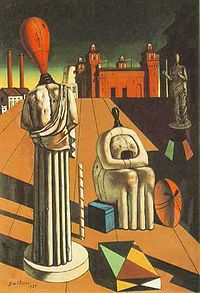
The Disquieting Muses
 Giorgio de Chirico
Style of painting that flourished c. 1910–20 in the works of the Italian painters Giorgio de Chirico and Carlo Carrà (1881–1966). The movement began with Chirico, whose dreamlike works with sharp contrasts of light and shadow often had a vaguely threatening, mysterious quality. Chirico, his younger brother Alberto Savinio, and Carrà formally established the school and its principles in 1917. Their representational but bizarre and incongruous imagery produces disquieting effects and had a strong influence on Surrealism in the 1920s.

Term applied to the work of Giorgio De Chirico and Carlo Carrà before and during World War I and thereafter to the works produced by the Italian artists who grouped around them. Pittura Metafisica was characterized by a recognizable iconography: a fictive space was created in the painting, modelled on illusionistic one-point perspective but deliberately subverted. In de Chirico’s paintings this established disturbingly deep city squares, bordered by receding arcades and distant brick walls; or claustrophobic interiors, with steeply rising floors. Within these spaces classical statues and, most typically, metaphysical mannequins (derived from tailors’ dummies) provided a featureless and expressionless, surrogate human presence. Balls, coloured toys and unidentifiable solids, plaster moulds, geometrical instruments, military regalia and small realistic paintings were juxtaposed on exterior platforms or in crowded interiors and, particularly in Carrà’s work, included alongside the mannequins. In the best paintings these elements were combined to give a disconcerting image of reality and to capture the disquieting nature of the everyday.


The Song of life
Giorgio de Chirico
Several major artists were attracted by this development: Mario Sironi’s totemic mannequins turned into brooding solitary figures; and Felice Casorati used steep perspectives leading to dark interiors as the settings for his models. In Germany the impact of the two Valori plastici travelling exhibitions (1921 and 1924) was considerable. Featureless mannequins began to appear in the work of George Grosz, Rudolf Schlichter and Oskar Schlemmer. The effect was felt most profoundly, however, by Max Ernst. On his arrival in Paris in 1922, Ernst’s painting reflected the admiration of his poet friends for de Chirico. At that time only one painter, Pierre Roy (a pre-war friend of de Chirico), showed the influence of metaphysical art, but the painters who became Surrealists after Ernst almost all passed through a period of stylistic debt to de Chirico, notably Salvador Dalí and Alberto Giacometti (the leading creators of the Surrealist Object), René Magritte and Paul Delvaux.

These groups—Novecento Italiano in Italy, Magic Realism in Germany and international Surrealism—carried the style into the 1930s. Although Carrà occasionally painted metaphysical works, it was only in the paintings of Savinio and de Chirico that the philosophical background of Pittura Metafisica persisted.

1 Haziran 2012 Cuma

Dada

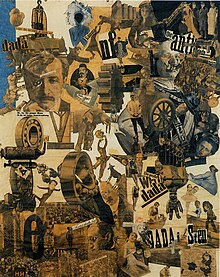
Cut with the Dada Kitchen Knife
through the Last Weimar Beer-Belly
Cultural Epoch in Germany
, 1919
Hanna Höch
Dada was, officially, not a movement, its artists not artists and its artnot art. That sounds easy enough, doesn't it? Of course, there is a bit more to the story of Dadaism than this simplistic explanation. Dadaism is a cultural movement that began in Zurich, Switzerland, during World War I and peaked from 1916 to 1922. To quote Dona Budd's The Language of Art Knowledge, "Dada was born out of negative reaction to the horrors of World War I. This international movement was begun by a group of artists and poets associated with the Cabaret Voltaire in Zurich. Dada rejected reason and logic, prizing nonsense, irrationality and intuition. The origin of the name Dada is unclear; some believe that it is a nonsensical word. Others maintain that it originates from the Romanian artists Tristan Tzara and Marcel Janco's frequent use of the words da, da, meaning yes, yes in the Romanianlanguage. Another theory says that the name "Dada" came during a meeting of the group when a paper knife stuck into a French-German dictionary happened to point to 'dada', a French word for 'hobbyhorse." The movement primarily involved visual arts, literaturepoetry, art manifestoes, art theorytheatre, and graphic design, and concentrated its anti-war politics through a rejection of the prevailing standards in art through anti-art cultural works. Its purpose was to ridicule the meaninglessness of the modern world as its participants saw it. In addition to being anti-war, Dada was also anti-bourgeois and socialist in nature.

Dada activities included public gatherings, demonstrations, and publication of art/literary journals; passionate coverage of art, politics, and culture were topics often discussed in a variety of media. The movement influenced later styles like theavant-garde and downtown music movements, and groups including surrealism, Nouveau réalisme, pop art and Fluxus.


Many Dadaists believed that the 'reason' and 'logic' of bourgeois capitalist society had led people into war. They expressed their rejection of that ideology in artistic expression that appeared to reject logic and embrace chaos andirrationality. For example, George Grosz later recalled that his Dadaist art was intended as a protest "against this world of mutual destruction."

According to Hans Richter, Dada was not art, it was "anti-art." Everything for which art stood, Dada represented the opposite. Where art was concerned with traditional aesthetics, Dada ignored aesthetics. If art was to appeal to sensibilities, Dada was intended to offend. Through their rejection of traditional culture and aesthetics, the Dadaists hoped to destroy traditional culture and aesthetics.

As Hugo Ball expressed it, "For us, art is not an end in itself ... but it is an opportunity for the true perception and criticism of the times we live in."

A reviewer from the American Art News stated at the time that "Dada philosophy is the sickest, most paralyzing and most destructive thing that has ever originated from the brain of man." Art historians have described Dada as being, in large part, a "reaction to what many of these artists saw as nothing more than an insane spectacle of collective homicide."

Years later, Dada artists described the movement as "a phenomenon bursting forth in the midst of the postwar economic and moral crisis, a savior, a monster, which would lay waste to everything in its path. [It was] a systematic work of destruction and demoralization... In the end it became nothing but an act of sacrilege."

  • Dada began in Zurich and became an international movement. Or non-movement, as it were.
  • Dada had only one rule: Never follow any known rules.
  • Dada was intended to provoke an emotional reaction from the viewer (typically shock or outrage). If its art failed to offend traditionalists, Dada writing - particularly Tristan Tzara's manifestoes - proved a fine, nose-thumbing Plan B.
  • Dada art is nonsensical to the point of whimsy. Almost all of the people who created it were ferociously serious, though.
  • Abstraction and Expressionism were the main influences on Dada, followed by Cubism and, to a lesser extent, Futurism.
  • There was no predominant medium in Dadaist art. All things from geometric tapestries to glass to plaster and wooden reliefs were fair game. It's worth noting, though, that assemblagecollage,photomontage and the use of ready made objects all gained wide acceptance due to their use in Dada art.
  • For something that supposedly meant nothing, Dada certainly created a lot of offshoots. In addition to spawning numerous literary journals, Dada influenced many concurrent trends in the visual arts (especially in the case of Constructivism). The best-known movement Dada was directly responsible for is Surrealism.
  • Dada self-destructed when it was in danger of becoming "acceptable".

Synchronism

Synchromism was an art movement founded in 1912 by American artists Stanton MacDonald-Wright and Morgan Russell. Their abstract "synchromies", based on a theory of color that analogized it to music, were among the first abstract paintings in American art. Synchromism became the first American avant-garde art movement to receive international attention. Synchromism is based on the idea that color and sound are similar phenomena, and that the colors in a painting can be orchestrated in the same harmonious way that a composer arranges notes in a symphony. Macdonald-Wright and Russell believed that by painting in color scales, their work could evoke musical sensations. It became abstract and expressive, hoping to unite visual and auditory stimuli through a symphony of color. This phenomenon of 'hearing' a color or the pairing of two or more senses--synesthesia--was also central to the work of Wassily Kandinsky, who was developing his own synesthetic paintings, or 'compositions', in Europe around the same time.

The abstract "synchromies" are based on color scales, using rhythmic color forms with advancing and reducing hues. They typically have a central vortex and explode in complex color harmonies. The Synchromists avoided using atmospheric perspective or line, relying solely on color and shape to express form.

The earliest synchromist works were similar to Fauvist paintings. The multicolored shapes of synchromist paintings also resembled those found in orphism. MacDonald-Wright insisted, however, that Synchromism was a unique art form, and "has nothing to do with orphism and anybody who has read the first catalogue of synchromism ... would realize that we poked fun at orphism".

Cliff Dwellers
George Wesley Bellows

Synchromism was developed by Stanton MacDonald-Wright and Morgan Russell while they were studying in Paris during the early 1910s. From 1911 to 1913, they studied under the Canadian painter Percyval Tudor-Hart, whose color theory connected qualities of color to qualities of music, such as tone to hue and intensity to saturation. Also influential upon MacDonald-Wright and Russell were the paintings of the Impressionists, Cézanne, and Matisse, which heavily emphasized color. Russell coined the term "synchromism" in 1912, in an express attempt to convey the linkage of painting and music.

The first synchromist painting, Russell's Synchromy in Green, exhibited at the Paris Salon des Indépendants in 1913. Later that year, the first synchromist exhibition by Macdonald-Wright and Russell was shown in Munich. Exhibits followed in Paris in October 1913, and in New York in March 1914. Macdonald-Wright moved back to the U.S. in 1914, but he and Russell continued to separately paint abstract synchromies. Synchromism remained influential well into the 1920s. Other American painters who experimented with Synchromism include Thomas Hart BentonAndrew DasburgPatrick Henry Bruce, and Albert Henry Krehbiel.

24 Mayıs 2012 Perşembe

Section d'Or


The Section d'Or ("Golden Section"), also known as Groupe de Puteaux or, was a collective of painters, sculptors and critics associated with Cubism and Orphism. Based in the Parisian suburbs of Puteaux and Courbevoie, the group was active from 1911 to around 1914, coming to prominence in the wake of their controversial showing at the Salon des Indépendants in the spring of 1911. This showing by Jean MetzingerAlbert GleizesRobert DelaunayHenri le Fauconnier and Fernand Léger, created a scandal that brought Cubism to the attention of the general public for the first time. The Salon de la Section d'Or further exposed Cubism to a wider audience. The group seems to have adopted the name Section d'Or to distinguish themselves from the narrower definition of Cubism developed in parallel by Pablo Picasso and Georges Braque in the Montmartre quarter of Paris, and to show that Cubism, rather than being an isolated art-form, represented the continuation of a grand tradition (indeed, the golden ratio had fascinated Western intellectuals for at least 2,400 years).

  The Puteaux Group (an offshoot of la Société Normande de Peinture Moderne) organized their first exhibition under the name Salon de la Section d'Or at the Galerie La Boétie in Paris, October 1912. Albert Gleizes and Jean Metzinger, in preparation for the Salon de la Section d'Or, published a major defence of Cubism, resulting in the first theoretical essay on the new movement, entitled Du "Cubisme" (published by Eugène Figuière in 1912, translated to English and Russian in 1913).
Jacques Villon 
Following the 1911 Salon exhibitions the group formed by Le Fauconnier, Metzinger, Gleizes, Léger and R. Delaunay expanded to include several other artists; Alexander ArchipenkoJoseph CsakyRoger de La Fresnaye,Juan Gris, and Jean Marchand, who were virtually unknown to the public before the Salon des Indépendants of 1911, began to frequent Puteaux and Courbevoie. František Kupka had lived in Puteaux for several years in the same complex as Jacques Villon.  Francis Picabia was introduced to the circle, perhaps by Guillaume Apollinaire(usually accompanied by Marie Laurencin) with whom he had recently become friendly. Most importantly was the contact established with Metzinger and the Duchamp brothers, who exhibited under the names of Jacques Villon, Marcel Duchamp and Duchamp-Villon. The opening address was given by Apollinaire. The participation of many of these artists in the formation of Les Artistes de Passy in October 1912 was an attempt to transform the Passy district of Paris into yet another art-centre; a further sign of a growing emphasis on communal activity that would culminate in the Section d'Or exhibit.

 La Chasse, 1911Albert Gleizes

After World War I, with the support given by the dealer Léonce Rosenberg, Cubism returned as a central issue for artists. With the Salons dominated by a return to classicism, Albert Gleizes attempted to resuscitate the spirit of the Section d'Or in 1920 but was met with great difficulty, despite support by Fernand LégerAlexander Archipenko,Georges Braque and Léopold Survage. Gleizes' organizational efforts were directed towards the re-establishment of a European-wide movement of Cubist and abstract art in the form of a large travelling exhibition; the Exposition de la Section d’Or. The idea was to bring together a collection of works that revealed the complete process of transformation and renewal that had taken place. It was not the success he had hoped for. Cubism was seen as passé for emerging artists and other established artists such as Marcel Duchamp and Picabia, although Gleizes, on the contrary, felt that only its preliminary phase had been investigated.
In addition to Cubists works (which already represented a wide variety of styles), the second edition of the Section d'Or held at the Galerie La Boétie from 5 March 1920 included De StijlBauhausConstructivism and Futurism. It was the revival of the Section d'Or which ensured that Cubism in general would become Dada's preferred target. The new polemic resulted in the publication of Du cubisme et des moyens de le comprendre by Albert Gleizes, followed in 1922 byLa Peinture et ses lois.

Der Blaude Reiter

 The Blue Rider (or in German Der Blaue Reiter) was a German Expressionist movement that was established in December 1911 by Kandinsky, Marc and Gabriele Münter. The group was founded by a number of Russian emigrants, including Vassily Kandinsky, Alexej von Jawlensky,Marianne von Werefkin, and native German artists, such as Franz Marc, August Macke and Gabriele Münter. Der Blaue Reiter was a movement lasting from 1911 to 1914, fundamental to Expressionism, along with Die Brücke which was founded in 1905. They shared an interest in abstracted forms and prismatic colors, which, they felt, had spiritual values that could counteract the corruption and materialism of their age. The flattened perspective and reductive forms of woodcut helped put the artists, especially Kandinsky, on the path toward abstraction in their painting. Painters Kandinsky and Marc worked on an almanac in which they showed their artistic conceptions. The title of the almanac, which then became the name of the group, Der Blaue Reiter (The Blue Rider), came from the painting by Kandinsky. His Blaue Reiter ( Blue Rider ) was an adventure in the simplification and stylization of forms and the connection between music and painting. 


Picture with an Archer, 1909
Vassily Kandinsky
The first exhibitions of The Blue Rider included works by Wassily Kandinsky, Franz Marc, Pablo Picasso, Paul Klee, Henri Rousseau, Robert Delaunay, and Arnold Schönberg. These artists, who early in their careers broke from the mainstream, were later to become the driving force behind modern art as we know it today. February 12 through April 2, 1912, the "Second exhibition of the editorial board of Der Blaue Reiter" showed works in "Black & White" (Zweite Ausstellung der Redaktion Der Blaue Reiter, Schwarz-Weiß) at the "New Art" Gallery of Hans Goltz (Neue Kunst Hans Goltz) in Munich. Within the group, artistic approaches and aims varied from artist to artist; however, the artists shared a common desire to express spiritual truths through their art. They believed in the promotion of modern art; the connection between visual art and music; the spiritual and symbolic associations of colour; and a spontaneous, intuitive approach to painting. Members were interested in European medieval art and primitivism, as well as the contemporary, non-figurative art scene in France. As a result of their encounters with cubist, fauvist and Rayonist ideas, they moved towards abstraction.

Der Blaue Reiter organized exhibitions in 1911 and 1912 that toured Germany. They also published an almanac featuring contemporary, primitive and folk art, along with children's paintings. In 1913 they exhibited in the first German Herbstsalon.

The group was disrupted by the outbreak of the First World War in 1914. Franz Marc and August Macke were killed in combat. Wassily Kandinsky, Marianne von Werefkin and Alexej von Jawlensky were forced to move back to Russia because of their Russian citizenship. There were also differences in opinion within the group. As a result, Der Blaue Reiter was short-lived, lasting for only three years from 1911 to 1914.

In 1923 Kandinsky, Feininger, Klee and Alexej von Jawlensky formed Die Blaue Vier (the Blue Four) group, and exhibited and lectured together in the United States in 1924.

An extensive collection of paintings by Der Blaue Reiter is exhibited in the Städtische Galerie in the Lenbachhaus in Munich.

28 Mart 2012 Çarşamba

Futurism

Giacomo Balla
Futurism came into being with the appearance of a manifesto published by the poet Filippo Marinetti on the front page of the February 20, 1909, issue of Le Figaro. It was the very first manifesto of this kind.
Marinetti summed up the major principles of the Futurists. He and others espoused a love of speed, technology and violence. Futurism was presented as a modernist movement celebrating the technological, future era. The car, the plane, the industrial town were representing the motion in modern life and the technological triumph of man over nature. Some of these ideas, specially the use of modern materials and technique, were taken up later by Marcel Duchamp (French, 1887-1968), the cubist, the constructivist and the dadaist.

Futurism was inspired by the development of Cubism and went beyond its techniques. The Futurist painters made the rhythm of their repetitions of lines. Inspired by some photographic experiments, they were breaking motion into small sequences, and using the wide range of angles within a given time-frame all aimed to incorporate the dimension of time within the picture. Brilliant colors and flowing brush strokes also additionally were creating the illusion of movement. Futurism influenced many other 20th century art movements, including Art Deco, Vorticism, Constructivism and Surrealism.

Futurists mixed activism and artistic research. They organized events that caused scandal. Everything was there to help them to glorify Italy and lead their country into the age of modernity. Certain Futurists vehemently promoted themselves to try to join forces with the Fascists, who were coming to power at the time. But Mussolini showed a preference for the Novecento Italiano, movement of artists who identified with the classical order and Italian heritage.

Futurism was a largely Italian movement, although it also had adherents in other countries, France and most notably Russia. Close to Futurism with its inspirations and motivations was Precisionism, an important development of American Modernism.

Although Futurism itself is now regarded as extinct, having died out during the 1920s, powerful echoes of Marinetti's thought, still remain in modern, popular culture and art. Futurism influenced many other 20th century art movements, including Art Deco, Vorticism, Constructivism and Surrealism.
Futurist Architecture
The Futurist architect Antonio Sant'Elia expressed his ideas of modernity in his drawings for La Città Nuova (The New City) (1912–1914). This project was never built and Sant'Elia was killed in the First World War, but his ideas influenced later generations of architects and artists. The city was a backdrop onto which the dynamism of Futurist life is projected. The city had replaced the landscape as the setting for the exciting modern life. They wanted to see the bare bones, the structure behind things as part of the aesthetic quality. Sant'Elia aimed to create a city as an efficient, fast-paced machine. He manipulates light and shape to emphasize the sculptural quality of his projects. Baroque curves and encrustations had been stripped away to reveal the essential lines of forms unprecedented from their simplicity. In the new city, every aspect of life was to be rationalized and centralised into one great powerhouse of energy. The city was not meant to last, and each subsequent generation was expected to build their own city rather than inheriting the architecture of the past.Futurist architects were sometimes at odds with the Fascist state's tendency towards Roman imperial-classical aesthetic patterns. Nevertheless, several Futurist buildings were built in the years 1920–1940, including public buildings such as railway stations, maritime resorts and post offices. Examples of Futurist buildings still in use today are Trento's railway station, built by Angiolo Mazzoni, and the Santa Maria Novella station in Florence. The Florence station was designed in 1932 by the Gruppo Toscano (Tuscan Group) of architects, which included Giovanni Michelucci and Italo Gamberini, with contributions by Mazzoni.

The Legacy of Futurism

Futurism influenced many other twentieth century art movements, including Art Deco, Vorticism, Constructivism, Surrealismand Dada. Futurism as a coherent and organized artistic movement is now regarded as extinct, having died out in 1944 with the death of its leader Marinetti, and Futurism was, like science fiction, in part overtaken by 'the future'.
Nonetheless the ideals of Futurism remain as significant components of modern Western culture; the emphasis on youth, speed, power and technology finding expression in much of modern commercial cinema and culture. Ridley Scott consciously evoked the designs of Sant'Elia in Blade Runner. Echoes of Marinetti's thought, especially his "dreamt-of metallization of the human body", are still strongly prevalent in Japanese culture, and surface in manga/anime and the works of artists such as Shinya Tsukamoto, director of the "Tetsuo" (lit. "Ironman") films; Marinetti's legacy is also obvious in philosophical ingredients oftranshumanism, especially in Europe. Futurism has produced several reactions, including the literary genre of cyberpunk—in which technology was often treated with a critical eye—whilst artists who came to prominence during the first flush of the Internet, such as Stelarc and Mariko Mori, produce work which comments on Futurist ideals.

A revival of sorts of the Futurist movement began in 1988 with the creation of the Neo-Futurist style of theatre in Chicago, which utilizes Futurism's focus on speed and brevity to create a new form of immediate theatre. Currently, there are active Neo-Futurist troupes in Chicago, New York, and Montreal.

26 Mart 2012 Pazartesi

Die Brücke

Otto Mueller
In 1905 the artists' association "Brücke" was founded by four students of architecture - Ernst Ludwig Kirchner, Fritz Bleyl, Erich Heckel, and Karl Schmidt-Rottluff - in the city of Dresden.

Die Brucke made use of a technique that was controlled, intentionally unsophisticated and crude, developing a style hallmarked by expressive distortions and emphases. Die Brucke artists often used color similar to the Fauves, and they were also influenced by art form from Africa and Oceania.

Some of the painters in the group sympathized with the revolutionary socialism of the day and drew inspiration from Van Gogh's ideas on artists' communities. Die Brucke expressionists believed that their social criticism of the ugliness of modern life could lead to a new and better future.

The Group Members
 
Ernst Ludwig Kirchner 
Apart from their own artistic work, "Brücke" members two most important aims were to establish contact with artists of similar convictions and to introduce their anvant garde art to the public through collective exhibitions. In 1906 Max Pechstein and Emil Nolde joined the group, followed by Otto Mueller in 1910. In order to emphasize the international aims of the modernist movement, foreign artists such as Cuno Amiet, Kees Van Dongen, Axel Gallén-Kallela and others were contacted as well.

The "Brücke" style attempts the creation of pure expression through colour and form. Painted motives such as landscapes or nudes in natural settings become the symbolic expression of an inner experience of the world. Forms and shapes are reduced to their essentials and express the artist’s subjective feelings. Traditional rules of perspective and academic proportion are abandoned to heighten immediacy. In this context the artists gained important impulses from their examination of the art of indigenous peoples. Colour too was soon detached from naturalistic representation and became a means of expressing of emotion: it was applied radiantly with impulsive and spontanious brushstrokes.

   
Ernst Ludwig Kirchner
Artistin Marcella , 1910
Brücke-Museum, Berlin 


The founding members of Die Brücke in 1905 were four Jugendstil architecture students: Fritz Bleyl (1880–1966), Erich Heckel (1883–1970),Ernst Ludwig Kirchner (1880–1938) and Karl Schmidt-Rottluff (1884–1976). They met through the Königliche Technische Hochschule (technical university) of Dresden, where Kirchner and Bleyl began studying in 1901 and became close friends in their first term. They discussed art together and also studied nature, having a radical outlook in common. Kirchner continued studies in Munich 1903–1904, returning to Dresden in 1905 to complete his degree. The institution provided a wide range of studies in addition to architecture, such as freehand drawing, perspective drawing and the historical study of art. The name "Die Brücke" was intended to "symbolize the link, or bridge, they would form with art of the future".
Die Brücke aimed to eschew the prevalent traditional academic style and find a new mode of artistic expression, which would form a bridge (hence the name) between the past and the present. They responded both to past artists such as Albrecht DürerMatthias Grünewald and Lucas Cranach the Elder, as well as contemporary international avant-garde movements. The group published a broadside calledProgramme in 1906, where Kirchner wrote:
"We call all young people together, and as young people, who carry the future in us, we want to wrest freedom for our actions and our lives from the older, comfortably established forces."
Fritz Bleyl
Die Segel, 1905 
As part of the affirmation of their national heritage, they revived older media, particularly woodcut prints. The group developed a common style based on vivid color, emotional tension, violent imagery, and an influence from primitivism. After first concentrating exclusively on urban subject matter, the group ventured into southern Germany on expeditions arranged by Mueller and produced more nudes and arcadian images. They invented the printmaking technique of linocut, although they at first described them as traditionalwoodcuts, which they also made.
The group members initially "isolated" themselves in a working-class neighborhood of Dresden, aiming thereby to reject their own bourgeois backgrounds. Erich Heckel was able to obtain an empty butcher's shop on the Berlinerstrasse in Friedrichstadt for their use as a studio. Bleyl described the studio as:
"That of a real bohemian, full of paintings lying all over the place, drawings, books and artist’s materials — much more like an artist’s romantic lodgings than the home of a well-organised architecture student."